The Moffatt Bible
New Testament, 1913. James Moffatt, The New Testament: A New Translation in Modern Speech, by James Moffatt, based upon the Greek text by von Soden. London: Hodder and Stoughton, 1913. Revised 1917. The Old Testament was published in New York in 1924-1925 (2 vols.), followed by a single-volume edition of the complete Bible in 1926.
Bible, 1926. James Moffatt, A New Translation of the Bible, Containing the Old and New Testaments. New York: Doran, 1926. Revised edition, New York and London: Harper and Brothers, 1935. Reprinted, Grand Rapids: Kregel, 1995.
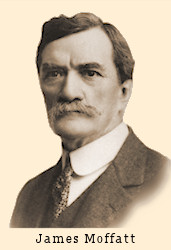 James Moffatt (1870-1944) was born and educated in Glasgow, Scotland. He entered the ministry and then became Professor of Greek and New Testament Exegesis at Mansfield College, Oxford in 1911. He returned to Glasgow in 1915 as Professor of Church History at the United Free Church College. From 1927-1939 he was Washburn Professor of Church History, Union Theological Seminary, New York. He died in New York in 1944.
Moffatt produced his translation of the New Testament while he was serving as Professor of Greek and New Testament Exegesis at Oxford, and its reception was so favorable (in the more liberal churches) that he undertook the Old Testament in order to produce a complete Bible. The version is highly colloquial, and allows the reader to quickly follow the progress of thought in many passages (especially in the Epistles) where a more literal rendering makes for difficult going. But Moffatt’s version was controversial in several respects. His preface put forth skeptical views concerning the truthfulness of the Bible. In the Old Testament he indicated by the use of different type fonts the hypothetical source documents of the Pentateuch (J, E, P, D), and frequently rearranged passages according to his idea of how they might have originally stood. For the New Testament he used the Greek text of Hermann von Soden, which was generally regarded as an eccentric text, and he often substituted conjectural emendations for the text of both Testaments. In the New Testament alone he adopts some thirty conjectures unsupported by any manuscripts. The translation throughout was highly readable, but often embodied interpretations that were objectionable to some. Roman Catholics and Lutherans were especially offended with Matthew 26:26, “Take and eat this, it means my body.” Moffatt later served as executive secretary of the committee of translators for the Revised Standard Version.
Ephesians 1:1–2:10
American Standard Version (1901)
1 Paul, an apostle of Christ Jesus through the will of God, to the saints that are at Ephesus, and the faithful in Christ Jesus:
2 Grace to you and peace from God our Father and the Lord Jesus Christ.
3 Blessed be the God and Father of our Lord Jesus Christ, who hath blessed us with every spiritual blessing in the heavenly places in Christ:
4 even as he chose us in him before the foundation of the world, that we should be holy and without blemish before him in love:
5 having foreordained us unto adoption as sons through Jesus Christ unto himself, according to the good pleasure of his will,
6 to the praise of the glory of his grace, which he freely bestowed on us in the Beloved:
7 in whom we have our redemption through his blood, the forgiveness of our trespasses, according to the riches of his grace,
8 which he made to abound toward us in all wisdom and prudence,
9 making known unto us the mystery of his will, according to his good pleasure which he purposed in him
10 unto a dispensation of the fulness of the times, to sum up all things in Christ, the things in the heavens, and the things upon the earth; in him, I say,
11 in whom also we were made a heritage, having been foreordained according to the purpose of him who worketh all things after the counsel of his will;
12 to the end that we should be unto the praise of his glory, we who had before hoped in Christ:
13 in whom ye also, having heard the word of the truth, the gospel of your salvation, —in whom, having also believed, ye were sealed with the Holy Spirit of promise,
14 which is an earnest of our inheritance, unto the redemption of God’s own possession, unto the praise of his glory.
15 For this cause I also, having heard of the faith in the Lord Jesus which is among you, and the love which ye show toward all the saints,
16 cease not to give thanks for you, making mention of you in my prayers;
17 that the God of our Lord Jesus Christ, the Father of glory, may give unto you a spirit of wisdom and revelation in the knowledge of him;
18 having the eyes of your heart enlightened, that ye may know what is the hope of his calling, what the riches of the glory of his inheritance in the saints,
19 and what the exceeding greatness of his power to us-ward who believe, according to that working of the strength of his might
20 which he wrought in Christ, when he raised him from the dead, and made him to sit at his right hand in the heavenly places,
21 far above all rule, and authority, and power, and dominion, and every name that is named, not only in this world, but also in that which is to come:
22 and he put all things in subjection under his feet, and gave him to be head over all things to the church,
23 which is his body, the fulness of him that filleth all in all.
2:1 And you did he make alive,when ye were dead through your trespasses and sins,
2 wherein ye once walked according to the course of this world, according to the prince of the powers of the air, of the spirit that now worketh in the sons of disobedience;
3 among whom we also all once lived in the lust of our flesh, doing the desires of the flesh and of the mind, and were by nature children of wrath, even as the rest: —
4 but God, being rich in mercy, for his great love wherewith he loved us,
5 even when we were dead through our trespasses, made us alive together with Christ (by grace have ye been saved),
6 and raised us up with him, and made us to sit with him in the heavenly places, in Christ Jesus:
7 that in the ages to come he might show the exceeding riches of his grace in kindness toward us in Christ Jesus:
8 for by grace have ye been saved through faith; and that not of yourselves, it is the gift of God;
9 not of works, that no man should glory.
10 For we are his workmanship, created in Christ Jesus for good works, which God afore prepared that we should walk in them.
|
Moffatt Bible (1935)
Paul, by the will of God an apostle of Jesus Christ, to the saints who are faithful in Jesus Christ: grace and peace to you from God our Father and the Lord Jesus Christ.
Blessed be the God and Father of our Lord Jesus Christ who in Christ has blessed us with every spiritual blessing within the heavenly sphere! He chose us in him ere the world was founded, to be consecrated and unblemished in his sight, destining us in love to be his sons through Jesus Christ. Such was the purpose of his will, redounding to the praise of his glorious grace bestowed on us in the Beloved, in whom we enjoy our redemption, the forgiveness of our trespasses, by the blood he shed. So richly has God lavished upon us his grace, granting us complete insight and understanding of the open secret of his will, showing us how it was the purpose of his design so to order it in the fulness of the ages that all things in heaven and earth alike should be gathered up in Christ—in the Christ in whom we have had our heritage allotted us (as was decreed in the design of him who carries out everything according to the counsel of his will), to make us redound to the praise of his glory by being the first to put our hope in Christ. You have also heard in him the message of the truth, the gospel of your salvation, and in him you also by your faith have been stamped with the seal of the long-promised holy Spirit, which is the pledge and instalment of our common heritage, that we may obtain our divine possession and so redound to the praise of his glory.
Hence, as I have heard of your faith in the Lord Jesus and your love for all the saints, I never cease to give thanks for you, when I mention you in my prayers. May the God of our Lord Jesus Christ, the glorious Father, grant you the Spirit of wisdom and revelation for the knowledge of himself, illuminating the eyes of your heart so that you can understand the hope to which He calls us, the wealth of his glorious heritage in the saints, and the surpassing greatness of his power over us believers—a power which operates with the strength of the might which he exerted in raising Christ from the dead and seating him at his right hand in the heavenly sphere, above all the angelic Rulers, Authorities, Powers, and Lords, above every Name that is to be named not only in this age but in the age to come—he has put everything under his feet and set him as head over everything for the church, the church which is his Body, filled by him who fills the universe entirely.
And as with us so with you. You were dead in the trespasses and sins in which you moved as you followed the course of this world, under the sway of the prince of the air—the spirit which is at present active within those sons of disobedience among whom all of us lived, we as well as you, when we obeyed the passions of our flesh, carrying out the dictates of the flesh and its impulses, when we were objects of God’s anger by nature, like the rest of men. But, dead in trespasses as we were, God was so rich in mercy that for his great love to us he made us live together with Christ (it is by grace you have been saved); together with Christ he raised us and seated us within the heavenly sphere in Christ Jesus, to display throughout ages to come his surpassing wealth of grace and goodness toward us in Christ Jesus. For it is by grace you have been saved, as you had faith; it is not your doing but God’s gift, not the outcome of what you have done—lest anyone should pride himself on that; God has made us what we are, creating us in Christ Jesus for the good deeds which are prepared beforehand by God as our sphere of action.
|
Bibliography
- James Moffatt, The Historical New Testament: Being the Literature of the New Testament Arranged in the Order of Its Literary Growth and According to the Dates of the Documents: A New Translation, edited with Prolegomena, Historical Tables, Critical Notes and an Appendix, by James Moffatt (Edinburgh: T. & T. Clark, 1901).
- James Moffatt, The New Testament: A New Translation in Modern Speech, by James Moffatt, based upon the Greek text by von Soden (London: Hodder and Stoughton, 1913). Revised ed., 1917.
- James Moffatt, The New Testament: A New Translation by James Moffatt, Together with the Authorized Version (London: Hodder & Stoughton, 1922). Presents the two versions in parallel columns.
- James Moffatt, The Old Testament: a New Translation by James Moffatt (London: Hodder and Stoughton, 1924).
- James Moffatt, A New Translation of the Bible: Containing the Old and New Testaments (London: Hodder and Stoughton, 1926). A revised edition appeared in 1935, and was reprinted as The Bible: James Moffatt Translation with Concordance by Kregel Publications in 1995 and 2004.
- James Moffatt, ed., The Moffatt New Testament Commentary, Based on The New Translation by the Rev. Professor James Moffatt, D.D. and under His Editorship. A 17-volume series published by Hodder and Stoughton between 1926 and 1950, in which various scholars (mostly British) provide a theological commentary upon the text reproduced from Moffatt’s translation.
- William John Gant, ed., Moffatt Bible Concordance: A Complete Concordance to The Bible, A New Translation by James Moffatt (New York: Harper & Brothers, 1950).
- F.F. Bruce, The English Bible, A History of Translations (Oxford, 1961), chapter 13.
Reproduced here is the preface to Moffatt’s translation of the New Testament, as it appeared in The New Testament: A New Translation (London: Hodder and Stoughton, 1913).
* * * * *
In his essay on Protestantism, de Quincey has a characteristic paragraph upon the popular delusion that “every idea and word which exists, or has existed, for any nation, ancient or modern, must have a direct interchangeable equivalent in all other languages.” No one who attempts to translate any part of the New Testament is likely to remain very long under such a delusion. Thus there is no exact English equivalent for terms like λογος and μυστηριον and δικαιοσυνη. The first of these I have simply transliterated once or twice; “Logos” is at any rate less misleading than “Word” would be to a modern reader. Even when an equivalent can be got for some New Testament term like εθνη or ῾Αιδης, it cannot be used invariably. I have kept “Gentiles” for εθνη in cases where the contrast between Judaism and the outer world is prominent; if Kipling’s “Recessional” was intelligible to modern readers, “Gentiles” here should not cause them undue difficulty. But now and then the Greek term carries a sense which can only be represented by our “pagans” or “heathen,” and occasionally it is no more than “nations.” This will serve as an illustration of the difficulties which confront a translator. But once the translation of the New Testament is freed from the influence of the theory of verbal inspiration, these difficulties cease to be so formidable. I have tried not to sacrifice the spirit to the letter. It is true, as de Quincey observes in the same essay, that “the great ideas of the Bible protect themselves. The heavenly truths, by their own imperishableness, defeat the mortality of languages with which for a moment they are associated.” Still, this is a victory in which even the camp-followers or translators have a modest share. They can or they should further this linguistic triumph. Hellenistic Greek has its own defects, from the point of view of the classical scholar, but it is an eminently translatable language, and the evidence of papyrology shows it was more flexible than once was imagined. My intention, therefore, has been to produce a version which will to some degree represent the gains of recent lexical research and also prove readable. I have attempted to translate the New Testament exactly as one would render any piece of contemporary Hellenistic prose; in this way, students of the original text may perhaps be benefited. But I hope also that the translation may fall into the hands of some who know how to freshen their religious interest in the meaning of the New Testament by reading it occasionally in some unauthorized English or foreign version, as well as into the hands of others who for various reasons neglect the Bible even as an English classic. This is a hope which, no doubt, is accompanied with some risks and fears. Every translation has to face a double ordeal. Some of its readers know the original, some do not, and both classes have to be met. “The English reader,” as Dr. Rouse remarks, “may be quite competent to judge of a translation as literature and as intelligible or not intelligible, but he cannot judge of its accuracy. The scholar alone can judge of its accuracy, but (granting that he has literary taste) he knows the original too well to be independent of it, and hence cannot judge of the impression which the translation will make on the minds of those who are not scholars.” If this is true of Homer, it is three times true of the New Testament. Any new translation starts under a special handicap. It appears to challenge in every line the rhythm and diction of an English classic, and this irritates many who have no knowledge of the original. The old, they say, is better. They are indifferent to the changes which recent grammatical research has necessitated in the translation of the aorist, the article, and the particles, for example, even since the Revised Version of 1881 was made. But intelligibility is more than associations, and to atone in part for the loss of associations I have endeavoured to make the New Testament, especially St. Paul’s epistles, as intelligible to a modern English reader as any version that is not a paraphrase can hope to make them.
This raises one of the numerous points of difficulty that beset the translator. How far is he justified in modernizing an Oriental book? How far can he assume that certain turns of expression have become naturalized in English by the Authorized Version itself? I have never seen any satisfactory solution of this problem, and I have not been able to find one. However, it is superfluous to discuss such matters at length. This is not the place to develop any theories on the subject. What the general public cares for is a translator’s practice rather than his principles, and students can easily detect the latter, or the lack of them, in the former.
I wish only to add this caution, that a translator appears to be more dogmatic than he really is. He must come down on one side of the fence or on the other. He has often to decide on a rendering, or even on the text of a passage, when his own mind is by no means clear and certain. In a number of cases, therefore, when the evidence is conflicting, I must ask scholars and students to believe that a line has been taken only after long thought and only with serious hesitation.
The translation has been made from the text recently issued by Von Soden of Berlin, but I have not invariably followed his arrangement and punctuation. Wherever I have felt obliged to adopt a different reading, this is noted at the foot of the page.
Quotations or direct reminiscences of the Old Testament are printed in italics.
The books are arranged for the convenience of the general reader in the order of the English Bible. This applies to the order of chapters as well. Thus the last four chapters of Second Corinthians appear in their usual canonical position instead of in what I believe to be their original position between First and Second Corinthians. The only exception I have made to this rule is in the case of some occasional transpositions either of verses or of paragraphs, for example, in the case of the Fourth Gospel. Any one who cares to look into the evidence for such changes will find it in my Introduction to the Literature of the New Testament.
Lastly, it is right to add that I have not consulted any other version of the New Testament in preparing this work, though probably echoes and reminiscences have clung to one’s mind. The only version I have kept before me is the one I prepared thirteen years ago for my Historical New Testament. But the present version is not a revision of that. It is an independent work. I agreed to undertake it with sharp misgivings, but I trust that the spirit and method of its composition may at any rate do something to make some parts of the New Testament more intelligible to some readers.
JAMES MOFFATT.
1913.
The following paragraphs are from the Introduction of Moffatt’s “Revised and Final Edition” of the complete Bible, dated 1934, as published in A New Translation of the Bible containing the Old and New Testaments (New York and London: Harper & Brothers, 1935), pp. xix-xx.
* * * * *
… Now the traditional or “massoretic” text of the Old Testament, though of primary value, is often desperately corrupt. At a number of places, for example in Genesis xxxv, 22, Judges iii. 7, 1 Samuel xiii. 1, Jeremiah iii. 1, and Zechariah vi. 15, It is broken or defective, though our English version usually conceals this. At other points it is in such disrepair that no conjecture can heal it. Such passages I have been content to leave with three dots ( ... ). A longer line of dots, in the poetical books, means that a line of the original text is either missing or too defective to be restored with any certainty, even with the help of the versions. Few scholars will judge that these marks occur too often; indeed, some may think that they ought to have been used more frequently. But, wherever I was satisfied with some correction or conjecture which at least made tolerable sense, I preferred to adopt it. When the choice lay between a guess or a gap, I inclined to prefer the former, feeling that the ordinary reader for whom this version is designed would have a proper dislike of gaps. I can assure him that they have been reduced almost to a bare minimum, and that wherever one does occur it means that the translator could not candidly patch up the text, even by using any of the patches devised by his predecessors.
Since nearly every page contains some emendation of the traditional text in the interests of accuracy and point, it has been impossible to annotate them. Scholars and students will recognize them readily, and I must ask the general reader to believe that none has been admitted except upon what the translator regards as sufficient evidence. This may seem to involve a large act of faith. But very few, apart from those who have done some first-hand work upon the subject, realize how uncertain and precarious is the traditional text of some books in the Old Testament. It would have swollen the book inordinately to have justified either the readings or, for the matter of that, the renderings one after another. Besides, to do this would be, in the words used by the translators of the Authorized Version, “to weary the unlearned, who need not know so much, and trouble the learned, who know it already.”
Then, even after a more or less sound text has been secured, it has to be rendered into adequate English, and here the common burden of translators is doubled, for one is never quite sure how far the influence and associations of the Authorized Version have acclimatized some Oriental expressions in our language. The Old Testament is a collection of Oriental books, Oriental in thought as well as in form. No translation can hope to be faithful and forcible unless it manages to preserve as much as possible of the Oriental flavour of the original texts, and yet there must be an effort to bring this far-off world nearer to the modern mind, an effort which may occasionally forbid the translator to be literal.
Again, several of the most characteristic Hebrew terms, religious, social, and psychological, have no English equivalent which exactly corresponds to their original meaning. Something is dropped as they are passed from Hebrew into English. Even the rhythm of the prose as well as of the verse cannot be carried over into our modern language without a certain amount of alteration, if the version is not to be pedantic. Furthermore, the habit of playing upon words, acrostics, euphemisms, paranomasia, and verbal tropes of this kind, baffles the translator, who may be reduced to the desperate expedient of suggesting within brackets (as, for example, at Genesis iii. 20 and Micah i. 10,11) the point of some allusion or piece of popular etymology.
One crucial instance of the difficulty offered by a Hebrew term lies in the prehistoric name given at the exodus by the Hebrews to their God. Strictly speaking, this ought to be rendered “Yahweh,” which is familiar to modern readers in the erroneous form of “Jehovah.” Were this version intended for students of the original, there would be no hesitation whatever in printing “Yahweh.” But almost at the last moment I have decided with some reluctance to follow the practice of the French scholars and of Matthew Arnold (though not exactly for his reasons), who translate this name by “the Eternal,” except in an enigmatic title like “the Lord of hosts.” There is a distinct loss in this, I fully admit; to drop the racial, archaic term is to miss something of what it meant for the Hebrew nation. On the other hand, there is a certain gain, especially in a book of lyrics like the Psalter, and I trust that in a popular version like the present my choice will he understood even by those who may be slow to pardon it.
It is obvious from what has been said above, that the books of the Old Testament are, for the most part, books which have been either made out of books or edited more or less drastically by later hands. Sometimes a book has passed through both of these processes. Now, I have avoided complicating the translation with unaesthetic marks of sources; but, particularly in the earlier historical books, I have been obliged as an honest translator to distinguish one or two of the strata which have been fused and confused in the traditional text. This has been done only when I found it to be absolutely necessary, for example, to disentangle two separate forms or fragments of a story, as in the case of the Judahite narrative (J) and the narrative originating in Northern Israel (E), which have been drawn upon in the Pentateuch. Wherever it has been necessary to mark an extract from the former, it is printed in italics, while any material from the latter appears within single square brackets ([ ]). When a passage occurs both in italics and also within these brackets, as for example in the case of Exodus iv. 13-16, this denotes an extract from the combined edition of J and E, prepared a century or two after they had begun to circulate separately. All the rest of the text I have left in ordinary type, without making any attempt to indicate the various sources from which it has been derived. The only other mark which requires a word of explanation is the double square brackets ([[ ]]). This denotes, throughout the entire Old Testament; passages which are either editorial additions or later interpolations.